
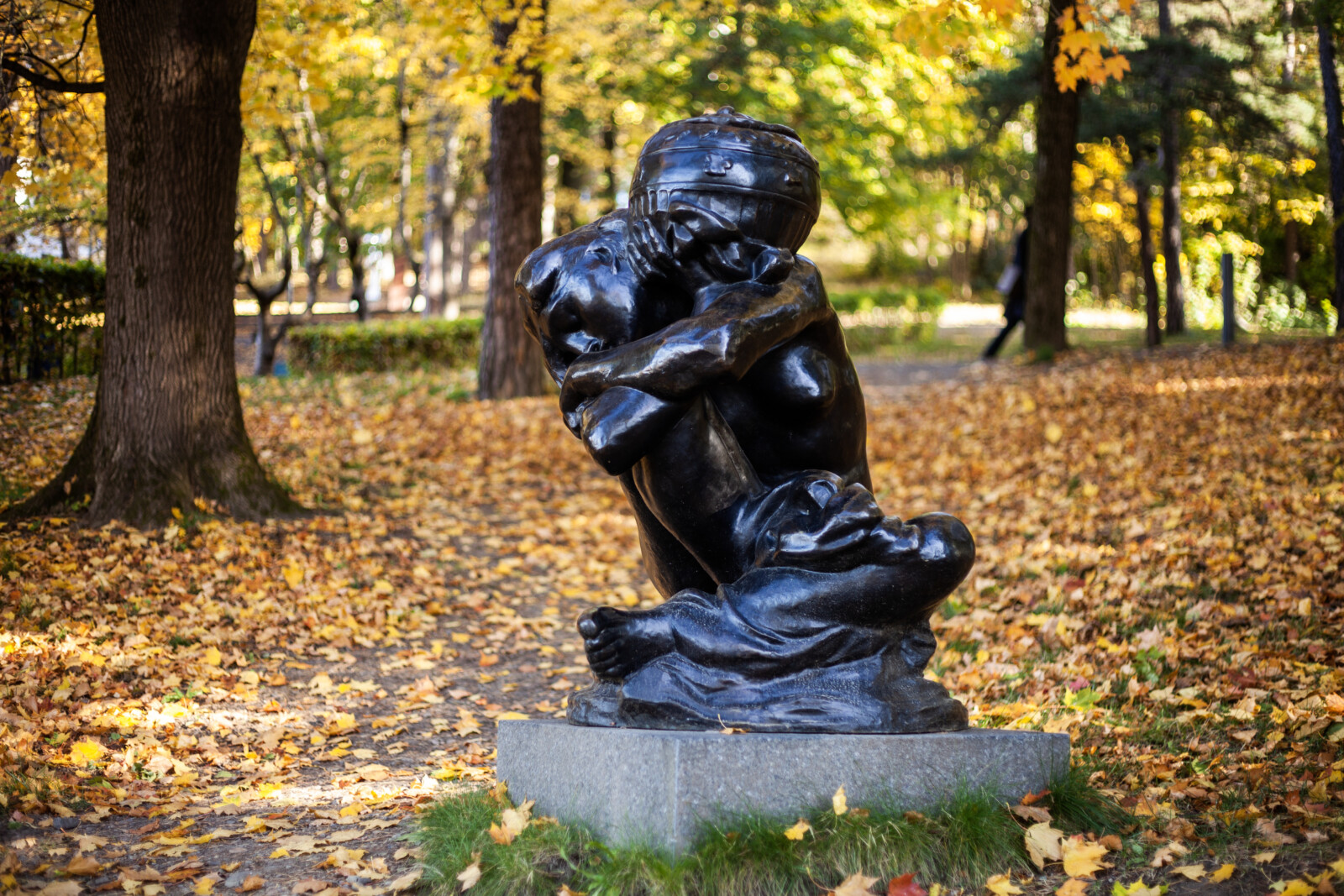
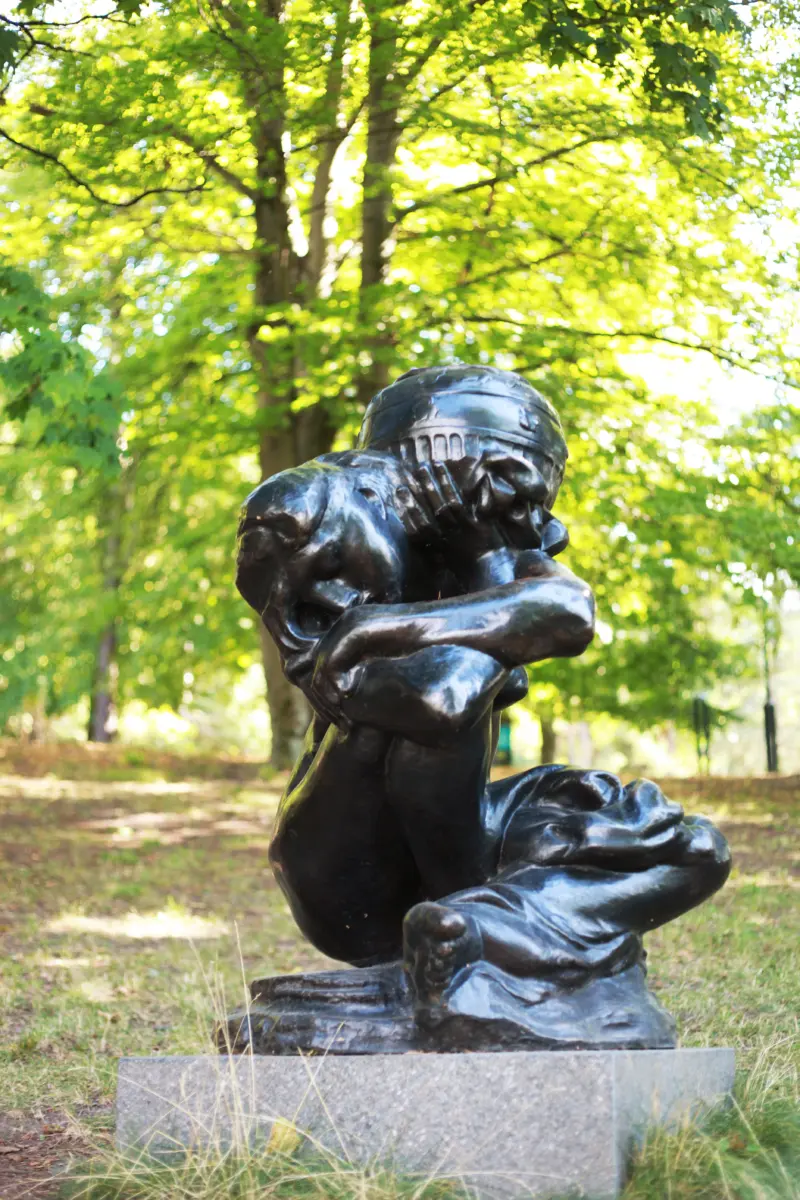
Cariatide Tombée à l’Urne
- Date 1880
- Unveiled 2013
- Material Bronse
- Dimensions 123 cm
Photo: © Kristina A. Kvåle /Ekebergparken
«Nothing immoral can ever exist in art. Art is always hallowed.»

Photo: © Gertrude Käsebier/Bettmann/Corbis/NTB Scanpix
Auguste Rodin
(b. Paris, France, 1840-1917)
Auguste Rodin is one of the world’s most famous sculptors in the figurative and realistic style. In his work, one can clearly see the influence of the Greco-Roman antiquity. But also, other movements, such as the neo-Gothic. It became clear to Rodin early on that he wanted to become an artist, but the path was long and difficult. In the 1880s, however, success was a fact, and by the turn of the century he was internationally recognised as an artist. The fact that he left traces of the modelling process, even in the finished works, was groundbreaking for his time.
Originally, Cariatide tombée à l’urne was meant for the upper left corner of Rodin’s magnum opus, The Gates of Hell (La Porte de l’Enfer, ca. 1880-1890), a large bronze gate that was meant to be the entrance to a museum building that was never built, Musée des Artes Décoratifs in Paris. The collection later became part of the Louvre. This entrance was to be encircled by numerous figures, many of which he produced individually in various sizes. One of them is Ève, the second Rodin sculpture in the park.
A caryatid is an architectural term from antiquity denoting a column or pillar shaped in a female form. Cariatide Tombée à l’Urne hasn't been able to keep upright but has collapsed under the burden of the urn. Auguste Rodin himself considered this to be one of his best compositions.
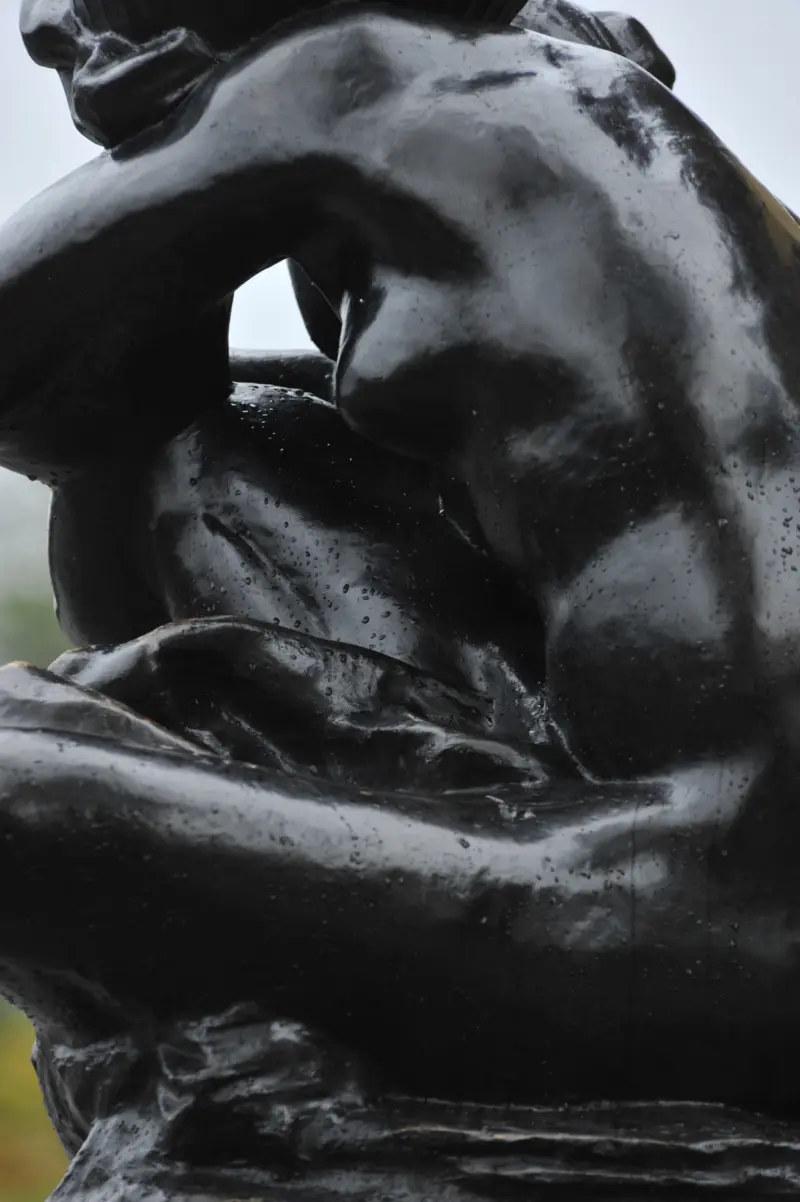
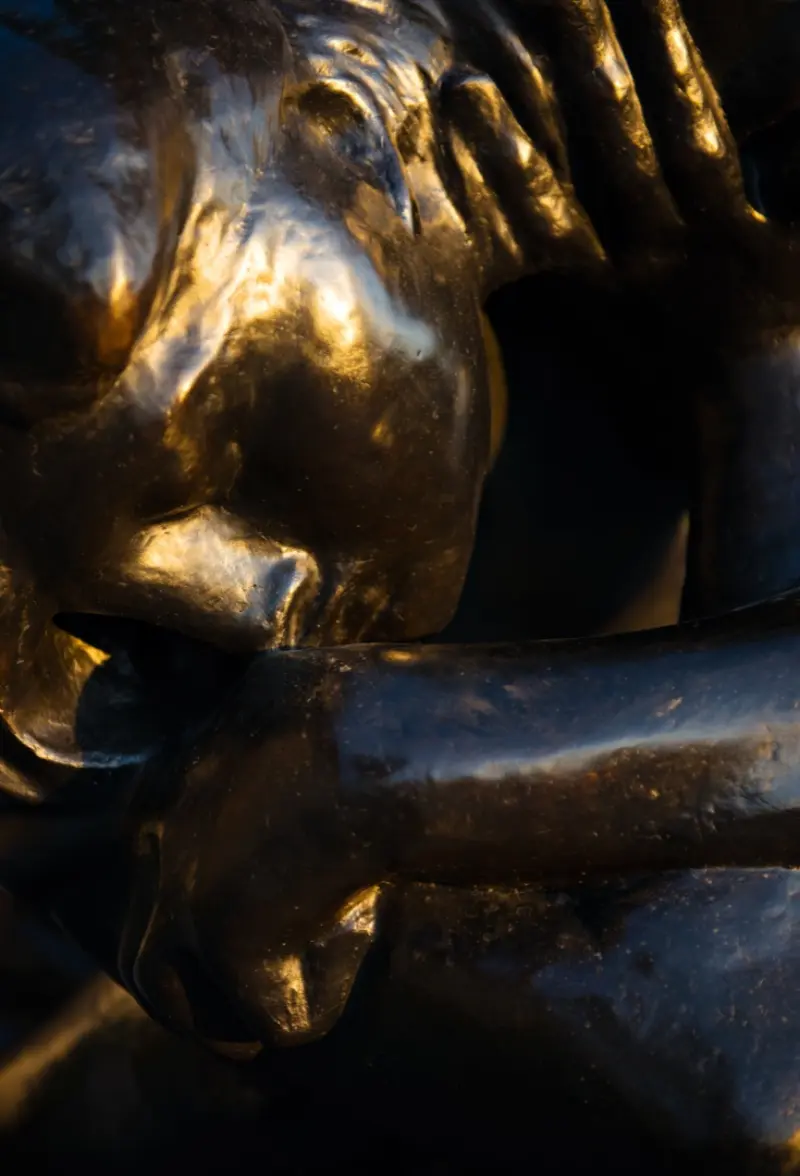
Rodin sculpted the human body in a naturalistic and idealized way, depicting movement and expressing emotion. He was hugely inspired by Michelangelo (1475- 1564). Rodin became a champion of realism in his time and is often seen as the founder of modern sculpture.
For The Gates of Hell he made over two hundred figures, including The Thinker, and they served as sources for his sculptural work throughout his career. Rodin was inspired by Dante Alighieri’s (1265-1321) Divine Comedy (1472) and used this as a starting point for his depictions of human suffering. The work on The Gates of Hell was originally supposed to take five years, but it became a kind of obsession for Rodin – his main work, and continued for 37 years, until his death in 1917. During Rodin’s lifetime, the work existed only in plaster form in his studio in Meudon, on the outskirts of Paris. Jules Mastbaum, founder of The Rodin Museum in Philadelphia, had The Gates of Hell cast in bronze in 1925 – in an edition of two, one for Philadelphia and one for the Musée Rodin in Paris.
The most well-known examples of caryatids from antiquity are from the Erechtheion, a classical temple at the Acropolis in Athens (ca. 421-406 BC). The classical caryatids hold the weight of the temple roof with quiet dignity, but Rodin’s caryatid has collapsed and lost her function as a weight bearing element. She is a fallen and almost crushed figure. Rodin’s caryatid represents a human being under the heavy weight of fate. In the original composition, the caryatid carried a rock and was entitled Sorrow. Like so many of Rodin’s depictions of human suffering, she carries an impossible burden without any hope of release. The Caryatid is often seen as a personification of fate. Despite the fatalistic and pessimistic symbolism, Rodin brings out the beauty in human suffering. The sculpture exists in eight individual and monumental versions; several exhibited at the Musée Rodin.
Guided tours
Experience Cariatide Tombée à l’Urne and many of the other artworks in the collection with our art mediators. We offer guided tours for private groups all year round.